






The creation of the Gemological Institute of America in the 1930s responded to a need for objective, standardized criteria for the analysis and classification of diamonds. The GIA certificate was therefore established to address a lack of consistency in the valuation of gemstones, which prior to this relied solely on the experience and sometimes questionable good faith of dealers and sellers. This certificate is based on the analysis of 4 objective criteria: cut, color, clarity, and carat weight. All this information and more is ratified by the GIA certificate provided with diamonds above a certain carat weight.
What is a GIA certificate?

Recognized worldwide for its reputation and objectivity in evaluating the finest gemstones, the GIA promises precision, reliability, and traceability for every diamond entrusted to it for analysis. A GIA certificate is issued only after the diamond has undergone rigorous, standardized testing under strictly identical objective conditions using scientific methods.
Each certificate features a report number that allows for verification by the jeweler when acquiring a diamond, as well as by the customer to whom a signed copy is provided upon purchase.
In addition to proving the quality of the gemstone, the GIA certificate can be useful for insurance purposes, as companies often prefer to refer to this document in addition to the jeweler's invoice to mitigate the risk of fraud.
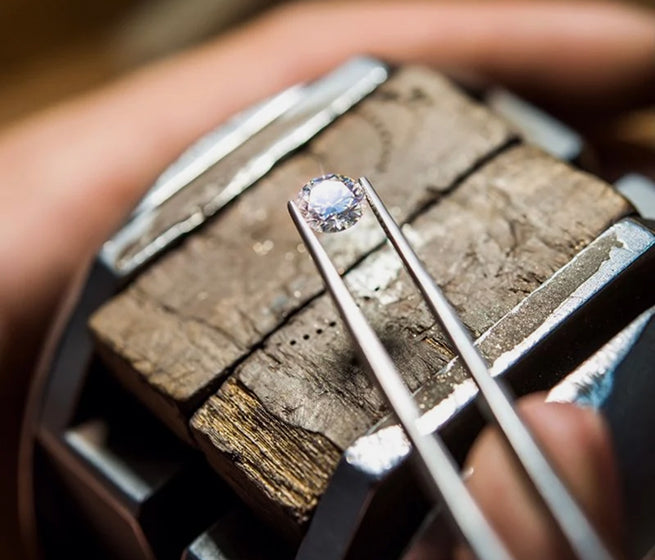
To this end, every GIA-certified diamond has its report number laser-inscribed on its girdle.
A GIA certificate is not mandatory, but it is a mark of absolute trust. At Manipura, we prefer to provide one with larger diamonds, such as our 0.6 or 1-carat diamond earrings.
How to read and understand a GIA diamond certificate?
A GIA certificate contains a wealth of information—more intended for professionals than customers—as it justifies the gemstone's price and provides the jeweler with valuable insights for its use. In addition to the report number, the certificate indicates all the diamond's characteristics with great precision: its dimensions measured to the tenth of a millimeter, its origin, and, above all, the diamond's 4Cs.
The diamond's weight is noted in carats, each equivalent to 0.2 grams. This is followed by the stone's color, indicated by an alphabetical scale from D to Z, which evaluates its natural coloration. The most sought-after diamonds are graded D, E, or F, which are nearly colorless to the naked eye. This is generally what is expected of a high-quality diamond, although some jewelers may sometimes look for a specific tint for an original piece of jewelry. To understand the color scale indicated on the GIA certificate, refer to the following classification: DEF: the diamond is colorless. GHIJ: the diamond has a subtle hint of yellow. KLM: the diamond is visibly yellow. It becomes increasingly brown as you approach Z. These colorations are compared against master stones (reference stones) by GIA gemologists.
The shape of the stone once cut is clearly stated, such as round, marquise, brilliant, etc. This factor depends solely on the precision and skills of the lapidary who crafted the stone.
Finally, the clarity criterion is indicated on the certificate according to an English-language scale ranging from Flawless to Visibly Included.
In addition to these criteria, gemologists include comments in the certificate regarding the quality of the polish, the symmetry of the cut, and the fluorescence, which is tested under UV light.
All these data are supported by numerous annotated diagrams indicating the exact measurements of the stone, the position of impurities or inclusions, and more.
It concludes with a blank space for any comments from the gemologist if necessary. This section is primarily used for historic diamonds.
Verifying the authenticity of a GIA certificate

The authenticity of the certificate is essential to prove the value of the gemstone to your insurer and to justify your claim in the event of loss or theft. It is therefore very important to ensure its legitimacy when acquiring a piece of fine jewelry. The first step is to verify that the number engraved on the diamond's girdle exactly matches the one indicated on the GIA report. The institute's website allows you to enter this number into their search database to retrieve the corresponding report from their archives. If your certificate number and the report itself match, you can be certain that the diamond set in your wedding band is authentic and that its value is justified.
By choosing Manipura, you have the absolute assurance that every gemstone has been rigorously analyzed and that its value is unquestionably justified by the authority of the GIA.